Tuesday, 6 July 2010

EUROPEAN STRESS OF BANK STRESS TESTS - a sovereign debt battle at sea

The Credit Crunch and recession is like a great sea-battle. All banks like the great galleons at The Battle of Trafalgar have been damaged, some boarded and taken for prize money, some broken up and sunk, and all variously crippled having to try to return to port in the one of the greatest storms of the century, just like the enormous storm that battered all survivors after Trafalgar in 1805, victors and defeated alike. The Credit Crunch and recession has become a competitive battle between countries to see who can look least damaged and take the prize money thanks to the sovereign debt crisis, which as the last G20 meeting showed has this year severely weakened the collective spirit of G20 that we are all in this together and must cooperate to solve what is a global not a national problem.
The new message is that it is every country for itself, and this changes the use and meaning of stress tests by the banks. What looked like a climatic disaster for the global economy is now turning into a battle between countries. Germany defeated Greece and the PIIGS in the Euro Area, but the Euro Area is now at economic banking war with the Anglo-Saxons, USA and UK, within the EU and transatlantic. At stake may be the coming recession for the Euro Area and how deep and prolonged this will be. But, I know that there will not be a comparable or even roughly precisely similar modeling of the stress test scenarios by all banks; they will each be as different as the pictures shown here of the battle of Trafalgar, partial, subjective, and incomplete. Public transparent stress tests in the middle of the sovereign debt crisis concern risks whether the Euro Area can hold together as well or better than the G20 agenda, or whether the Euro Area splits between externally strong and externally weak states, surplus and deficit countries, competitive and less competitive.
These are the analyses of banks in each national sector that we experts will be examining. The Euro Area does not seem to have recognised and decided openly that sharing a common currency means they are mutually dependent. There remain strong political voices advocating the break-up of the Euro Area, letting some sink so that others can survive. Sensible people know that way lies defeat for all. Euro Area divided will lose and set back for another generation Europe's dream of action as a counterweight of equal strength in the world to the Anglo-Saxon economies who do operate as a group even though not formally so. Greece, Spain and Ireland thought Euro membership protected them; it hasn't. Germany and other export-led economies, including far-flung China, think they are protected by their trade surpluses, and have yet to discover fully that is not so either! Stress tests by banks are like war gaming, and at least as complex as a sea battle between two gigantic fleets. They are a regular requirement dictated by law, by Europe's CRD (Basel II and Solvency II) legislation adopted by each EU member state. the "stress tests" are central to Pillar II of Basel II.
Arguably, the Credit Crunch was worse than it would have been if only the major banks in Europe had focused earlier on Pillar II and completed Pillar II before the crisis; none of them did so! They had been advised strongly by audit firms (insofar as they said clearly banks must begin by building up their historical data including data covering at least one earlier recession) and consultancies like myself to start with Pillar II back in 2005 and not to wait until Pillar I implementations were complete; none did so!
It is debatable if the regulators communicated the same signals. I don't think they did even though intelligent regulators knew long ago that Pillar I of Basel II was really only a temporary learning process and that Pillar II is the entire battleground of risk regulations. They knew this at least by 2007 when it was obvious banks were dragging their anchor chains on Pillar II work, if not earlier, including about the inter working required with IFRS accounting standards that also reflect the scenario modeling requirements of Pillar II stress tests etc. What is Pillar II?
It is not merely the supervisory pillar as the audit firms wrongly advised by simplifying or summarising the meaning of Pillar II. Pillar II requires firms to combine all their risk exposures into a set of macro models with scenarios based on cyclical changes in the underlying economies. Essentially it is all about getting banks to understand how their performance depends on the macro-economy. Unfortunately this was not a message they either understood or wanted to hear. Bankers are deeply suspicious of power grabs in the boardroom by economists 9who would then displace mere accountants and mathematicians) despite the latter showing no signs whatsoever of being hungry for such responsibility. Economists were not involved by banks in their efforts to build econometric models for scenario stress testing. The regulators required them to forecast using current risk accounting data in the context of a range of severe economic downturn factors. Bankers assumed this could be done by simply tweaking their risk accounts and the result universally was amateur hour quality. You can see it in the results and also in the recipe provided of headline numbers the banks were tasked to work with, not unlike battles led by generals who had never seen a war, didn't know what a whole fleet or army even looks and behaves like. Banking had not only become too complex for traditional regulations but also too complex for management, for new management that unlike traditional predecessors had less than a comprehensive understanding of basic banking.Then in 2008 and 2009 along came just such a crisis, full-on war of survival, survival of those banks who could look at least relatively better than others, and as they had avoided modelling full recession, but also Credit Crunch, which effectively more than doubled the losses that they should have had calculations in place to anticipate. If they had been more on their own case I calculate their capital buffers and reserves would have been half as much again, but this would only have ameliorated half of the Credit Crunch impacts. Governments would still have had to step in. But, in any case, only the US and UK met the crisis with sufficient financial muscle and innovation. There was little prospect of banks surviving unaided unless regulators were more on the ball about systemic risk already by 2006 at the latest, but in every country that was less the remit of regulators, more the responsibility of central banks, who weren't asleep at the tiller on the poop deck and in the conning tower so much as merely lacking a sense of urgency to get anywhere fast. They relied too much on visual sightings from the crow's nest, lacked a plan and lacked modern guidance systems to see over the horizon.G20 and Government ordered stress tests on both sides of The Atlantic in 2009
With the Credit Crunch and resulting recession suddenly stress tests were no longer about speculating about an indeterminate time in the future, but about what is happening all around and in the banks yesterday, today and tomorrow, modeling the war while fighting it. But clarity was now precious and just as hard in the fog of war. This changed the character of stress tests as defined in the regulations to a real world modeling exercise with real data and lots more of it to be urgently computed than any theoretical abstract ideas hitherto had offered banks to work with. Banks, however, found themselves more lost than ever about where they were and to start and how to do such sophisticated intellectually demanding and at the same time dangerous work. While before capital reserve ratios were at risk now the banks saw stress tests as threatening to their independence and solvency! To make matters worse the banks were now being told in no uncertain terms by governments, using a force majeure that the central banks and regulators had not dreamed before the crisis they could muster, to do stress tests pronto beginning with the top banks in the USA and where the stress tests in the Spring of 2009 were not about years hence but about their economic capital over the next 6 months! They still did not employ their economists, leaving such corporately sensitives matter toa few trusted risk experts and accountants who are generally hopeless at economic models. Why, because economics is about dynamic changes over time, over months, quarters and years, and not about point in time cut-off audit figures for tax purposes; a wholly different game, a different language and culture. The USA results were eventually published but months later, only once the world had moved on.
Europe followed suit for its top banks and decided to keep the results secret. The reason for all this secrecy was less to do with corporate confidentiality or fear of the Jacobin mob and more to do with fear of real economists calling the whole exercise amateur, lies or even a sick joke. Economists weren't that interested, however; banking has always been somewhat beneath them. Traditionally finance was considered by economists to be immaterial to how economies behave - they have been learning a new hard lesson about that, but the lessons haven't yet sunk in and I suppose many economists are reluctant to acknowledge what they dangerously overlooked for so long. Sensible academics know better than to get involved in institutional mess of others just as the best bankers knew to steer clear of risk because there are no bonuses in risk management.Now in 2010 all these stress tests are to be done again and banks have to consider the impact of an imminent recession and to think of it as double dip. banks hate this because it goes against their entire approach to Basel II, having believed it should be a way of reducing their capital requirements when it is obvious to all that the stress test results merely give regulators the perfect excuse to raise capital ratios to two or even three times what banks currently hold. They wouldn't do that, but the ammo is there should they wish to, to turn the clock back on capital reserve ratios to those prevailing 50 or more years ago!
In Europe, because of the sovereign debt crisis that has shifted the targets of capital markets short term speculators from attacking individuals banks to attacking all of national banking sectors, governments are fearful about the stress tests too and anxious that they should put their own banks in a competitively (defensive) good light. Even the very intelligent and feisty Christine Lagarde is anxious to use the tests as a good PR. That is of course the exact opposite of what the stress tests are for; they are for measuring worst-case not for showing relative better case.
In the case of France there is considerable suspicion that french banks have got away (with only a few exceptions) almost scot-free in their balance sheets, which look as though there had been almost no credit crunch or recession. German banks have not been so lucky and have had to evidence more financial embarassment than french banks. Belgian and Dutch banks were holed sunk (Fortis, ASBN-AMRO and Dexia) while ING and Rabobank were only holed above the waterline and continue to sail merely minus a few of their mainsails.The results of bank stress tests will show that the eurozone’s financial services industry is in good health, France's finance minister Christine Lagarde has stated, thinking of course first and foremost about the reputation of France and her banks in the sovereign debt crisis. She made the comments at a conference as she announced that the test results will be unveiled on July 23rd. Financial regulators and watchdogs have been running the tests to quell investor concerns over the stability of the banking sector within the territory. But this is not what they are for! Banks are also worried now that they may be facing additional pressures from special taxes, regulation and stricter rules surrounding capital requirements, which they are already trying to postpone, the so-called Basel III requirements for higher economic capital buffers and liquidity reserves and for contributions to stabilisation funds. Ms Lagarde said: “You will soon be seeing the number of banks that will be submitted to the stress test, you will have better understanding of the exact criteria we apply and of how heavily we stress the system.”
There is a French phrase "un coup de Trafalgar" which one might be forgiven for thinking it relates to be defeated. The phrase is certainly in the minds of the French, but "Non, pas de tout!" Un coup de Trafalgar translates as “an underhand trick.” You’ve got to love and admire the French who can turn defeat into a sneer, and there is something of this in how all countries and banks are actually managing their stress tests on a national banking sector basis as an arena for trickery to show things are better than expects, understandable perhaps in the presence of a submarine wolf pack of hedge fund capital market speculators who are hoping to profit from break-up and defeat of the Euro system, a defensive line of ships that are being broken apart just like at Trafalgar.“Banks in Europe are solid and healthy,” Lagarde added.
The stress tests are expected to include approximately 100 of the largest banks in the Euro Area plus regional and local banks that are government owned. nationalised banks strictly do not have to comply with Basel II risk regulations but governments are concerned about how much their guarantees may be called upon and the embarassment this could means for budget deficits and national debts, given the parsimony of the ECB and the limits of the new €720bn stabilisation fund in the exclusive hands of the European Commission whose banking and accounting skills are not legendary. €720bn is five times one year's annual Commission budget. Has it got the what it takes to manage this responsibly or technically - non, pas dout! In the UK, the FSA claimed that it is not worried over what will be revealed about the health of UK banks by the tests. Is this also flag-waving? Adair Turner, chairman of the FSA, was quoted by the WSJ saying rigorous domestic analysis on British financial institutions has been ongoing since the start of 2009. Of course, except that it is still more a matter of great seamanship more than great technical means. The pan-European stress tests are overseen by the European Union’s Cebs as supervisor of supervisors. The tests are said to be bigger, potentially more credible – and certainly longer winded. But, from the point of view of the banks there is still not explicit miodel and formulae that they can follow precisely. They are still being relied upon to innovate their own models and that for banks is a huge challenge. At best it will be 2 or 3 years before this work can be called professionally credible, possibly not even then?
According to people involved in the European testing process, the initial exercise of testing the biggest banks in each country – 26 institutions had been done and is on schedule for publication on July 15. July 14 would have been a more resonant date. In my view if the tests and results are available by then, then the process has been far too rushed and the chances of credible results even less probably, certainly no time for boards to approve them and no time for any interative reworking to improve on the initial fag packet models.
CEBS questionnaires will have to be sent out via national banking regulators to about 125 institutions. The big question is whether the process will work in its aim to restore battered confidence in European banks. To repeat myself, if this is the aim it is wrongheaded according to the regulatory laws and the experts know that. European banks are worth 10 per cent less on average than two months ago, according to the FTSE Eurofirst 300 banks index. Enlarging the test should mean it takes to the end of July. I'd have specified end of September, but who wants to be worrying about all this while on their August holiday breaks.
Spain in particular is desperate to restore confidence in its banks quickly. Spain, which has tested all its banks according to CEBS guidelines is desperate to publish the results, has been instrumental in strong-arming other countries into extending the remit of the test, according to several people involved in the process. But, since this has become a competitive sovereign debt battle all have to publish, to fire their guns, at the same time. Germany was persuaded that to limit its test to only its three biggest banks was self-defeating, implicitly damning other untested institutions, notably the state-owned Landesbanken. The FT and others have commented that it is far from clear that the parameters of the tests will be tough enough to restore confidence across Europe. The same was said in 2009, and actually the CEBS tests are broadly a repeat of the exercise carried out in 2009, the quality of which I know to have been work that I would not pass if brought to me by first year undergraduates in either economic or business management school.
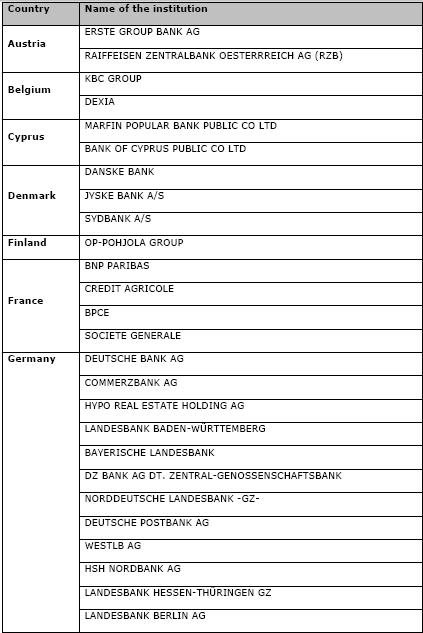
The banks to be stress-tested are:The parameters would be broadly a 3% GDP (in real inflation adjusted terms, which are useless for banks) undershoot, a 1% increase in unemployment and 10% further fall in property prices. Where is the figure for fall in corporate profits or spike in interbank borrowing rates, sovereign debt ratings and business profits wholly absorbed by debt servicing, insolvency rates and other such data - banks have to make those up.Adding to parameters widely seen as credible, CEBS is poised to settle on a higher hurdle rate for passing the test, increasing the number from a 4 per cent tier one ratio in last year’s test to 6 per cent this time, in line with the US stress test last year which helped restore confidence in banks there. This in itself is simplistically not the whole picture. The total capital reserves of all types and qualities should be included, including all capital buffers and other liquid and near-liquid reserves, including over the medium term between nominal losses to realised losses and collateral receovery and selling off business units. Net interest income is critical and this has to be modelled over a cycle, not based on point in time calculations. the results of all the stress tests will be predominantly point in time calculations.A key part in the exercise is how the tests choose to measure the sovereign debt risk impacts on the banks on both sides of the balance sheet. One regulator said to the FT that Europe had decided the test should assume a “haircut” of about 3 per cent on all eurozone sovereign debt investments. This is significant for otherwise highly rated instruments, but foolish as a general rule for all. 25% haircuts operate on asset swaps and 20% on debt restructurings such as Greece. That 3%, which is less than the haircut on most collateral receovery costs as already imputted in Basel II, will be controversial because it would discount solid German Bunds at the same rate as troubled Greek government debt. In that regard it is at least right because inflation alone could have that much impact, but of course how inflation is treated from real GDP to actual bank cash flows is a messy business.
“Given the difficulties, the preferable solution would be for each bank to disclose exposures so investors can base decisions on the facts, rather than questioning an imperfect test,” said Huw van Steenis to the FT, an analyst at Morgan Stanley. However, one senior official told the FT that the alternative idea of disclosing each bank’s sovereign holdings would be implemented as well. Combined with the running of simultaneous testing on a “top-down” basis by European authorities of the systemic macro-economic solidity of various banking sector exposures, such as commercial property, there is a growing belief that these stress tests could reassure the market sufficiently, as planned, is the FT's conclusion, adding that some analysts have suggested that panic about European banks’ exposure to sovereign debt could be overheated. All experts, including myself, agtree it is appallingly overheated and overheated by politicians as much as by speculators and runour-mongers and bloggers, but that the tests results will be reassuring I and other very much doubt, because the quality is easily comparable to the reassurances banks issued in 2008 saying they have no funding problems. The actual fact is that banbks do not know what their funding problems actually are because the uinterbank funding markets ahave been relatively closed in recent months and these tests are part of the battle, treated as a weapon not merely the half-time scorecard.Moody’s, the discredited, and in Europe deeply despised including openly by the ECB, credit rating agency, last month concluded that the largest lenders would be able to absorb “severe” losses on their exposure to Greek, Portuguese, Spanish and Irish assets without having to raise additional capital, after carrying out its own stress tests on more than 30 European banks. I believe them. It does not take much analysis at all to know that much. Moody's test assumed a forced sale of public sector bonds at 20 per cent below the steepest fall in market valuation in recent months, an event Moody’s described as very low probability.
The credibility of CEBS’s latest tests will hinge on whether enough weaker banks fail, said one senior central banker in London this week, reported by the FT. “The tests need to be published, the parameters need to be fully transparent, and some banks need to fail.” That is in my opinion silly and irresponsible because as anyone must know the authorities will intervene before absolute failure, and in any case we don't have perfect agreed measures for what counts as failure.
There are more competing theories for how to measure a banmk's insolvency than there are stress test factors and scenarios. Several industry groups, such as the British Banking Association, have come out against bank-by-bank disclosure, saying that league-table-like results could trigger a panic run on an otherwise healthy institutions. However, many bank chief executives and chief financial officers concede that full disclosure might be the only way to address investors’ concerns, according to the FT.
What all seem to miss is that this is in the sopvereign debt context now and therefore the stress tests are of national banking sectors, not about individual banks. This is macro-prudential systemic risk stuff not microprudential. Anyone liuving in the let some fail so others can survive better totally misunderstands the interdependencies of banks and of banks and economies. Christine Lagarde understands that. What the tests will again prove is that bankers don't understand the economics of banking, least of all investment bankers, no true perspective or realistic sense of proportion. Unfortunately our economies are in the hands of banmks as much as the banks are in the hands of the economies where they do business but neither lendfers nor customer want to acknowledge their vulnerability to the other. Governments and central banks understand what matters most in this crisis but they are being attacked and weakened by the buccaneers and privateers of the capital markets!

Tuesday, 29 June 2010

SOROS, TRICHET, MERKEL & IF PIIGS COULD FLY

Otto von Bismarck made a speech in 1862 saying, "The great questions of the time will not be resolved by speeches and majority decisions... but by iron and blood", and thereafter was known as The Iron Chancellor, an appellation all subsequent Kanzlers aspired to, some far too much so. of course. There is more than a whiff of iron in the air of the sovereign debt crisis, Governments' own Credit Crunch, iron being also the smell of blood. Angela Merkel and her Finanzeminister Herr Wolfie Schäuble have not appeared tolerant of Diskussionen, preferring summit policy agreement only by Edict of Maastricht, the Euro Growth & Stability Pact.
Since January there have been oft-repeated calls among politicians, public, market traders and newspapers for Greece (its commercial and treasury paper now junk status) to leave the Euro, then later calls for Germany to leave, and most recently France saying it might leave if Germany does not change its economic stance (these two countries being the only ones with triple AAA status left in the Euro Area!) Netherlands should have triple-A status except it allowed its biggest banks to collapse in ignominy (I hope Nout Wellinck becomes the next President of the ECB at the end of next year to replace Trichet?)
The UK stands hunched offshore, on the sidelines, hand-wringing, and navel-gazing only at its own public finances. Ireland, Spain,and Portugal are teeth-chattering to see who or what hits them next, Italy somewhat secure by comparison, a novel experience for Rome, and France feeling it must be the unity champion, but not if Germany fails to hold up its half of the EU project deal.
This story below is a reduced form of the debate, a triangle with Angela Merkel (whom the Daily Telegraph called "brass-necked") representing the EU's biggest economy that stands as creditor counterpart to most of the rest, Jean-Claude Trichet the Euro Area's financier ECB, and George Soros representing international capital markets.
Trichet has decided he must side with Germany that some might conclude is ECB's biggest paymaster, but also its biggest customer-borrower. Germany has net foreign assets of €1tn, while the rest of the Euro Area's is minus €2.5tn, and germany owna 40% of ECB's reserves. It's ex-Euro Area trade surplus also halves the rest of the EA's deficit. These apart from any other reasons are good ones for why ECB President Trichet should remain on Kanzler Merkel's good side.Trichet said after the G20 last week that "Merkel’s actions will boost confidence among households, investors and companies and will help consolidate the recovery", speaking to Italy's La Repubblica. That view is at odds with what many economists and veteren arbitrageur George Soros said on Wednesday, telling a Berlin audience why the euro is flawed: "By insisting on pro-cyclical policies, Germany is endangering the European Union... "I realize that this is a grave accusation, but I am afraid it is justified." Trichet dismissed this, saying the euro [EUR/$=1.2182] is a very credible currency that kept its value and guaranteed price stability for 11'5 years, with average annual inflation of 1.98% in the euro-zone. "A currency that guarantees such stable prices, it's of value in the eyes of domestic and international investors" Trichet told La Repubblica. Of course, as every investor knows, supposedly past performance is no guarantee guide to future performance. Yes, but?
The day before, Wednesday, Soros said that "by cutting its budget deficit and resisting a rise in wages to compensate for the decline in the purchasing power of the euro, Germany is actually making it more difficult for the other countries to regain competitiveness."
That is correct if Germany's €250bn foreign trade surplus is 60% earned within the EA, which I think the data allows us only to suppose to be probably true.
If so it's $120bn ex-EA surplus helps pay via the ECB for most of the rest of the EA's non-€ trade deficit with the rest of the world but for which it gets €150bn trade & payments gain from the rest of the EA, a nice trade. Netherlands also earns a substantial trade surplus, as do a few others, much of it from Germany as in Ireland's case. But, it is from the above interesting that we could put a figure of €50bn on how much more Germany should be importing annually net from the rest of the EA, which I suggest works out at a rise in gross imports from the rest of the EA of €200bn roughly to get a change in the net surplus of €50bn.
That means Germany increasing its imports by over 16%, and from the reast of the EA by 27% or three months worth. That is a big adjustment and practically impossible; looks easier and cheaper just to pay over €50bn annually, but how? The Europen Stabilisation Bank fund of €720bn of which €250bn is from the IMF (using EA member states deposits and drawing rights perhaps) equates to a decade of such payments if the balance all came evenNtually from Germany. Its contrubution is just shy of €150bn.
Merkel defended her actions last weekend, saying they will prevend future crises. Well, er, no, that's what they said about TARP in the USA. All experts are saying that Europe's banks have not disclosed their full losses from the Credit Crunch and Recession. Indeed, looking at some banks such as certain french banks, others too, one would be hard pressed to find signs of either Credit crunch or recession in the balance sheets such as BNPP, with certain notable exceptions as SocGen and of course the small local banks. But, experts can be wrong. Anglo-saxon experts would be wrong if they expect to find continental European banks except for Spain and Greece to be so heavily exposed to property as US-UK banks. The Netherlands banks bought in foreign property exposure e.g. Fortis, and ABN AMRO, ING too but less so, to their cost.
Ireland, remarkably for a small country with a surprisingly huge trade surplus, its banks ran with the credit-boomers, didn't lend to business much, lavished all on property lending and incurred a massive balance of payments deficit double-negating its trade surplus - truly bizarre! The UK banks lent far too heavily on property and mortgages but unlike Spain, and Ireland there is no poperty surplus so residential values fell less than expected, while only commercial property did the expected and tanked. hence, the collateral damage of Credit Crunch and recession is a curate's egg in Europe. let's not forget that Germany is another China in trade volume, surplus and massive over-lending to business while relatively neglecting property and household consumer lending.
In any case the Credit Crunch did not result in a Euro Area recession so much as a big short-lived negative growth shock from the USA-UK bow-wave. The Euro Area boat (Das Boot) has its normal recession still due, if it arrives on time, before this time next year! The socvereign debt crisis may take the blame including Germany's Iron Kanzlership, and people will talk of "double-dip" and UK will catch a feverish cold from it, a dunking from a Euro bow-wave, but actually this would be a misinterpretation. Continental Europe regularly has its recession 24-30 months out of synch with the Anglo-Saxon cycle. Hence, there is something tobe said for battening down the hatches on government finances to make some room for expansionery spending when recession hits.
Could Euro recession be avoided like the UK avoided recession in 2001 by pre-emptive spublic spending increases. The answer is possibly yes, but more probably no, because the Euro Area is too evenly split between credit-boom and export-led economies. Will another or prolonged crisis sound the death-knell for the Euro system, and also be triggered by assuming greater writedown losses to please the Anglo-Saxons, haha? The writedowns from Credit Crunch currently stand as follows: Whatever the triffers appear to be, the Euro System is in a "Merkel of all Crises" (Scots: muckle; US usage 'Mother') such that the Euro system's collapse is more probable than diplomats assume to be thinkable. The currency union may not break-up or the Euro actually crash to the floor, but the system must change. And, do not under-estimate the power of financial speculators to smell blood in the water and what they will do to garner the tens of $billions of speculative profits on fears of Euro-collapse, even if the Euro never truly falls apart! Pitted against that is the political will of the EU, which should prove stronger, not least to avoid political security crises within and along EU borders.
This is more than just deflation Risks. But Trichet does not believe that austerity measures being by European governments will cause deflation. can he back that up with systematic evidence - no! he hasn't got a macroeconomic model to tell him what to say on that score. his job is spin-doctoring for confidence raising.
Some bearish investors are betting that cuts in government spending across the European Union will add to deflationary pressures at a time when consumers and businesses are de-leveraging, lending and borrowing less, battening down until the storm passes.
Growth will fall sharply, with zero growth effect coming from household consumption, business investment or bank lending when government too is deflationery. Where is growth to come from? Will it be trade with the rest of the world or asset sales to foreignors? hardly. Whatever is imagined cannot be currently foreseen or computed by the financial markets experts, words I offer up with a dry taste and pained smile. Some speculators seem more like agent-provocateur rioters or muggers to me. Private sector deflation is pushing yields on 10-year bonds down to 2 percent, triggering a new wave of quantitative easing, Bob Janjuah, chief markets strategist at RBS told CNBC. Is that telling us something? Not in my book. Markets are not economists and they read their capital market screens like Chinese courtesans read tea-leaves.
"I don't think that such risks could materialisee," said the great seer Trichet, adding that inflation expectations are well anchored. They would be if deflation's coming? "As regards the economy, the idea that austerity measures could trigger stagnation is incorrect." one has to ask, why not? How can stagnation be triggered except by austerity on all fronts beginning with government? trichet has an answer to that chiming with merkel but totally opposite to Soros. This is not a love triangle at all! Reforming the real economy in each country in the euro zone is what is needed, according to Trichet.
That is just so easy to say and as anyone knows it is a long term gameplan, but not one that governments sho believe in leaving matters to free enterprise and financial markets engage in trying to achieve beyond a relatively passive (supply side fiscal economics) second guessing.
"We ask all governments to be determined to carry out structural reforms to increase the potential growth," trichete said. "I insist on the need to boost work productivity: in the medium- and long-term, growth depends right on this." If PIIGS could fly!
It is bizarre that Trichet can say Governments have to restructure, or economies do so, when we know it is already proving exceptionally hard to restructure the banks, something the ECB needs to take more responsibility for and relieve EA member states of the bruden on their budget balance sheets. None of this economic competitiveness restructuring can happen unless Europe's banks in all countries dramatically change the composition of their lending between productive and non-productive investment, from demand to output and vice versa. Export-led economies' banks are far too heavily exposed to industry assets and credit-boom economies' banks even more exposed to property assets. If the EU and EA simply rely on radically restructuring without coordination and financial rebalancing measures how the chips will fall may turn into a game of chance. The Commission's meisterwerk of a €720bn stabilisation fund appears to be a keystone, but it has to cope with Europe's banks refinancing €5 trillion in funding gap finance ove the medium term that could very easily take all of that and more.
There is more darkness to come before the dawning dawn.

Saturday, 6 March 2010

Verdammtnochmal; diese einseitige Konjunktor schon wieder! - of Europe' biggest economy!

GERMANY as usual yet again plays only its one note economic flute - a picture postcard to the rest of the world hiding a domestic ruthless economic selfishness that does not extend to its over 3.1 million unemployed and rising (or 5 million, 3 or 5 depending on your preferred measure)! Since the mid 1970s Germany has maintained a high unemployment rate and in most years a depressingly low consumer spending. The effect is partly borne by migrant workers, but less than imagined; very much by German youth and by early retirees. This coincides since the 1970s with local and regional government spending restrictions and cuts. German industry has been forced to rely heavily on exports. Germany's economy is a good example alongside Japan of how year after year substantial trade surpluses do not a happy economy make, and do not translate well into general economic growth. In US dollar terms the economy experienced long recessions and near-recession periods in the first half of the 1980s and second half of the 1990s and first half decade of the twenty-first century - half of the last three decades. These were only growth periods in Deutschmark terms.Both Germany and Japan have been inflation, export surpluses, high currency exchange rate, and monetary policy obsessed with one major difference, Germany kept its national debt low and unemployment high while Japan did the opposite. Both countries, however, sacrificed domestic consumer-led growth (thereby restricting imports) on the alter of exports above all else. They do not make happy trading partners - a model and brand followed by China that can at least claim some good reasons for doing so until now. Following their failures to become world military superpowers, Germany became mesmerised like Japan by the wonder of being perceived around the world as an economic superpower. Once the post-WW2 decades of reconstruction ended in the 1970s oil-price recession shock, since then Germany and Japan preened themselves as creditor nations, and in Germany's case especially the cost has been lower growth, mainly export-led and therefore high unemployment. Economic conservatism was excused for many years by national anxiety in general, a pervasive sense of economic insecurity, paranoid fear of inflation, and of hyper-inflation in particular. I know Germany very well and can confirm that these feelings of fearfulness were genuine even in the halcyon days of fast growth and full employment.
The second half of the twentieth century confirmed Germany's reputation as a strong economy, the world's engineer, a land of discipline, quality and precision in design as in manufacture. Japan developed a similar production ethos supplemented by diligent sales-marketing, reverse-engineering innovation, and price competitiveness. The problem is that what impressed foreign markets became the sum total of what impressed Germany and Japan about themselves! Their only wish is for this to continue indefinitely. Meanwhile German manufacturers have been not even reliant on German bank loans but able to self-finance investment and rely on bank borrowing in its trade partner countries. Today, Germany's goods exports are 41% ratio to GDP, one third more by value than total of German industrial output (compared to goods exports in UK of 17% ratio to GDP, 40% less by value than total UK industrial output, and 6% in USA, only 30% of total industrial output). Services in Germany are 66% of GDP, compared to 82% in UK and 77% in USA. Germany's imports are 33% ratio to GDP (half of which is energy and some of the rest for re-export), compared to imports ratio to GDP of 23% for the UK and 10% in the USA. Germany can claim to be a substantial importer, but its greater reliance on the external account bespeaks an repressed domestic economy. This, it was hoped by other EU members, would change with the Euro single currency whereby the German economy as the EU's largest (equal to UK and Spain combined) would open up more to become a more balanced two-way trading partner with the rest of the EU, not least because of the reconstruction and development of East Germany. That did not happen! German policy setters did not allow it to happen! The Einheitssteuer tax to fund reconstruction was sufficiently harsh to dampen demand in the whole country - it was a totally unnecessary tax other than helping to keep the economy relatively closed within the EU. Unlike the UK in the nineteenth century when it ran decades of trade deficits because of following a 'free trade' policy alone that benefited the growth of continental Europe more than the UK, Germany found ways of maintaining trade surpluses even within the free trade zone of all of the EU!
Germany’s reliance on manufacturing to spur export-led growth was highlighted on Friday by an exceptional spurt in industrial orders, reported as parliamentarians showed the fiscal discipline they are famous for by trimming €5.6bn from this year’s German budget. Industrial orders leapt by 4.3% in January, largest monthly increase since June '07, helped by the weaker euro.
The rebound followed a 1.6% fall in orders in December at the end of a period when de-stocking dominated over output investment. Eurozone services have been hit by weak domestic demand causing and caused by rises in unemployment and cut-back in governments' stimulus measures.
As usual, cuts in the German federal budget will mostly affect spending on welfare and job creation. This beggar-my-neighbour via trade action should trigger complaints from trading partners, especially in EU countries that have been urging Germany to increase public spending to stimulate domestic demand and help the recovery of the whole of the eurozone.But, like Japan, Germany is well-versed in evading domestic stimulation (also known as endogenous growth impulse). As a recipe for everyone else it is of course impossible for all others to similarly shift their policy stance to focus only on export-led growth; exporters need importers - if some countries insist on running high trade surpluses other countries have to run high trade deficits. It does not therefore behove Germany to tell Greece or any other countries how to manage their growth, and certainly not on the German model, a model that can only ever suit the few, not the many!
Members of the ruling centre-right coalition pushed through the cuts, which will trim government spending from €325.4bn ($443.5bn, £294.5bn) to €319.5bn, and reduce the forecast deficit for 2010 from €85.8bn to €80.2bn, to only 2% of GDP, which is simply callous, appallingly low when the EU and the rest of the world is recovering from recession, and shows an indifference to national unemployment, which today is only 16% below what it was in the Germany of 1933 (although 6 millions unemployed was only the official figure; other figures suggest 11 millions)!
There is a historic logic to Germany's obsession with exports. The German economy failed to heed the export mystique only in the years up to and after 1933-45 that was, however, also based on seeking economic independence from the global economy. Between 1910 and 1913, exports accounted for 17.8% of Germany's GDP, then 14.9% in the second half of the 1920s falling with the Great Hyperinflation and persisting in falling to only 6% in the second half of the 1930s under the Nazi regime, then the war. But by 1950 accounted for 9.3% of West Germany's GDP. With postwar economic boom, exports rose to 17.2% of GDP in 1960, and to 23.8% in 1970, rising through economic downs and ups and domestic retrenchment to 26.7% by 1980, and 33% in 1990, up to 41% today. Fine, but this cannot continue! The original budget was tabled by Wolfgang Schäuble, the finance minister, and proposed the highest deficit ever recorded in absolute terms – more than double the previous peak figure of €40bn (but if today only 1% of GDP!). The FT commented that "it is rare for parliamentarians in Germany to attempt to reduce federal spending, rather than try to increase budget lines for their favourite projects". Er, not so, what planet has the journalist been living on? The coalition government's majority Christian Democratic Union party and minority Free Democratic Party decided that Germany needed to send a signal to the rest of Europe – particularly in light of the ongoing Greek economic crisis and pressure on the euro. What Europe do they imagine they have been living in?
The gradual recovery of the German economy, and the continuing only relatively lower unemployment by Germany's high levels it has become inured to, made the cuts supposedly possible. The spending figures and the cuts were opposed by Social Democrats and Greens (a party I helped to found in the late 70s), but will be passed March 19.

Wednesday, 24 February 2010

CLUB MED COUNTRIES GET ROD OF IRON?

Portugal, Spain, Italy and Greece are all in breach of 3% Maastricht crieria budget deficits and 60% national debt to GDP ratios. That is an issue currently shaking the Euro system and is being talked up as a major challenge to EU integrity - even if everyone else in the EU are also in breach of the 3% ceiling for budget deficit ratios. It is not far fetched to point to a North-South EU divide between the self-proclaimed prudent beer-swilling cold-hearted North and an imprudent impudent wine-savouring sunny South, between an iron north and a malleable south? Passing our Edinburgh statue to one of my great great grandfathers, The Duke of Wellington (Duke of Douro in Portugal), I was reminded in a Radio 4 discussion about the history of UK national debt, by historian Niall Ferguson that Wellington was nicknamed the Iron Duke not for his defence of Portugal or for victory at Waterloo, but for installing iron shutters on his windows at Apsley House that were regularly being stoned, almost daily, by the mob protesting about economic hardships and his opposition to the Great Reform Bill in 1831. Today the stones are being thrown for similar reasons in the so-called 'Club Med' countries, and the The Guards charging the mob, who were nicknamed the "Piccadilly Butchers", are in today's EU supposedly the Germans. FT's Lex looked at the Club Med countries as a group perhaps because they are currently each experiencing street protests, sometimes violent, against budget cuts imposed. some say at the behest especially of 'Iron' Germany, to make them and all other fiscal recalcitrants comply with Maastricht deficit rules, that Germany itself is marginally in breach of? Two centuries ago, to help balance its books, the French under King Joseph invaded Andalusia and began the long two and a half year long bloody siege of Cadiz! Let's not indulge economic equivalents, to traduce the idea of the EU as having kept the military peace in Europe, only to replace it with open economic-warfare. The EU runs a modest trade deficit with the rest of the world. If Germany persists in maintaining a substantial export surplus internally and externally to the EU, then it has to live with the fact that many of its EU fellow member states must run deficits and therefore Germany has to buy the deficit countries' bonds to fund the current account imbalances.German politicians have particularly decried the profligacy of the Club Med states, no doubt mainly for domestic political consumption plus a little leverage at the loans negotiations. Athens politicians complain this is Berlin bullying and the mob and expert commentators agree. FT Lex says, "Amid a rash of strikes in Greece, Spain and Portugal, emotions are running high. Yes, Greece and the other big-spending Club Med countries must tighten their belts. They also need to increase their competitiveness. But to insist, as Berlin has done, that austerity is the only way out for these countries is both unrealistic and untrue. Germany must play a role too." I agree, except this is not yet the time for so-called 'belt tightening'. Much of the anciety is caused by the evidence of Greek sovereignty rating crisis hitting the Euro, example of tail wagging dog, or as Soros would say 'tails' given similar problems in Ireland, Portugal and Spain. Greece, Spain and Portugal, less so Italy, have been running large trade and current account deficits for many years. Italy, unlike the others, did not indulge in credit boom growth. In credit crunch terms, Italy has been the most prudent economy in the EU. The ECB has provided loans to support bank aid, abd as can be seen Germany and France have also received support.Last year, these current account deficits summed to about €127bn, of which trade deficits were €100bn, half of which was due to trade within the eurozone. The 4 countries shrunk their deficits significantly in 2008 and 2009's recession.
Germany, meanwhile, retained a large current account surplus of a $135bn (€120bn c/a), down from €200bn in 2007 – over half of which is from trade with EU partners. For decades Germany enjoyed export-led growth, while the rest of the EU supplied the demand for much of its exports - a synergy that continues.
Germany's advocacy of fiscal austerity may be merely political grandstanding or a genuine concern that market confidence is more important than economic realities - whichever? Even germany must know that if now the four Club Med countries deflate their way to shrinking their budget deficits to 3%/GDP ratios, this means a €135bn cut, or about 7% of German output - a huge slump in demand, including for imports -see data below.
And, then what if everyone has to do the same in the EU? Economies and markets do not run on straight lines. Maastricht criteria are an equilibrium ideal and the Euro is a strong currency protection of sorts, but underneath that allowance has to be made for very different, countervailing, if complementary, economic structures and growth policies. The kicker in all this of course is that The Euro and its Maastricht Treaty conditions are being levered to make the case for political union.
We took a big step in that direction with the Lisbon Treaty. But, so far, the new voting dispensation, our new President, the various councils, and the European Parliament, are not on the battle-scene.
As lex concludes, "Germany would not be able to substitute with increased exports to other countries. The economy, which is already stalled and only currently propped up by exports, would go into reverse. Berlin would then face some tough choices... If only out of self interest, German opposition to a Greek bail-out plan is therefore likely to soften."


Tuesday, 16 February 2010

ARE EURO STATES A MUTUAL SOCIETY OR NOT?

Otmar Issing, who was very important in dictating the form of European Monetary Union (EMU) has issued a provocative challenge using the fiscal embarrassment of Greece within the Euro Area. He makes several statements of partial facts. His purpose is to argue that EMU’s rules are absolute and can only be flexed by European Political Union (EPU), as if to swing the Euro rules like a bat on the pivot of Greece to hit a home-run for EPU, which he argues, as he did in the 1980s, should have preceded EMU. To be fair, Issing clearly dislikes the idea of leveraging EMU to gain EPU – that it should have been the other way about, but that is how he sees matters now standing.
What are his provocations? They include that the Euro Area system is a monetary stability system that does not permit any direct or indirect transfers of aid between member states. In truth, it does permit transfers far more than would be the case if the Euro did not exist. But, these are indirect transfers between states via inter-bank loans and bond sales i.e. private to finance trade deficits between states, for which, as the credit crunch crisis has shown us, central banks and state treasuries are ultimately solvency guarantors.
Jean-Claude Trichet, ECB President, also says, however, that there can be no special cases i.e. Greece can swap assets with the ECB for short term roll-over loans, but only if the assets are rated suitably high enough by the ratings agencies. This is a Catch-22 circular argument since the ratings agencies’ sovereign ratings for Greece are influenced by Greece’s EU, EMU and OECD membership, and too by the flexibility of the ECB’s lender-of-last-resort role. To play tough and say each state must absolutely balance its books as if there are no external circumstances, effectively makes policy responses to the credit crunch and recession within the Euro Area a hostage to the ratings agencies whose models and role in the crisis, while central, are profoundly discredited.
Issing concedes there are transfers at the full EU level via the budget of the European Commission, but he avoids any references to transfers via the short term money market operations of the ECB. In the 1980s, when EMU was conceived and Issing argued EPU first, EMU second, The Jacques Delors and European Recovery plans proposed up to a trillion in bond issuance that would be self-financing to provide for a system of transfers to ease the readiness for EMU. This sensible idea was voted for by all states except UK, Germany and The Netherlands. If today’s EU majority voting system had applied back then a system of transfers would have been part of the Maastricht, EMU and Euro treaties. I would go further and say if the EU had a system of transfers similar to what operates within sovereign states (to compensate for imbalances between regions) then there would surely be far more support and impetus towards EPU within the EU by now.
Issing says European taxpayers would not stand for ‘transfers’ from states who obey the rules to those who do not. But, following the rules is not the real issue and is not simple at any one point in time. It is more a question of what follows from very different economic growth policies within the EU. In the EU Single Market transfers are inevitable either private or public, interbank lending or inter-governmental transfers. When interbank lending (and buying and selling of net financial assets such as securitised bonds) broke down, governments everywhere have had to step into the breach. Greece may be rightly accused of running a far too high annual trade deficit and external account financing (up to 18% ratio to GDP). But its credit-boom led growth, while imprudent, was not outside of the rules. Indeed, Ireland, Finland, Greece and Spain were repeatedly praised for contributing to EU growth and jobs recovery much above their weight within the EU economy.
All states cannot seek after only export-led growth! For most of my lifetime it has been the case that the world economy has accommodated only a few net exporters (e.g. Germany, Japan and OPEC). The extreme special case of the past decade was that a few credit-boom economies (mainly the USA) generated trade deficits that allowed almost everyone else to generate surpluses or get nearer to balance. The conditions that led to the credit crunch were a boon to emerging countries generally, and of course to China.
What Issing neglects to say is that when states gave up their individual currencies they also handed all their off-balance sheet short term bonds operations (treasury bills) to the European Central Bank (ECB).
It has been precisely by using treasury bills that the UK and USA have been able to generate trillions of aid for their insolvent banks at no material cost to taxpayers – no taxpayers’ money applied, aid is off-budget in assets for treasury bill repo swaps. Greece, Ireland and Spain, and others in the Euro Area when directly bailing out their banks have had to issue bonds ‘ on budget’. They would not be in such fiscal difficulties if they could have relied on the ECB for a similar scale of money market response on behalf of the whole Euro Area and Single Market without regard to who got more or less help relatively.
The unstated implication of Issing’s argument is that only political union would permit such flexibility by the ECB. This is debatable. Some argue the ECB’s inflexibility is because it is not backed by political union. Another view, my own, is that the inflexibility comes from the EU being composed of countries that followed opposite growth impulses. Germany pursues export-led growth (why its employment gains have been less than others) alongside economies who pursued USA and UK style credit-boom growth (what we used to call deficit-led growth), such as Ireland, Greece and Spain, which meant having to sustain large trade deficits by selling financial assets. These diametrically opposing growth and monetary policies stymies the ECB in its response to the credit crunch.
Greece had further to go to catch up economically with the rest of the Euro Area and the banks went further than others in pushing a mortgage-led credit boom, and did so against Central Bank of Greece advice and in years when the ECB did not express its concerns. Like banks elsewhere, Greek banks capital reserves were wiped out and Government had to pick up a bill to provide support equal to one year’s GDP. But, Greece has to accommodate much of this ‘on-budget’ and that is hard to do and keep within the Maastricht Treaty rules.
Issing says “Emu is a “no transfers” community of sovereign states”. But, if taxpayers accept aid transfers internally between regions within states and externally at a global level why not within the EU? Does the ECB constitution and treaty really forbid ‘special cases’. Statements by Trichet and EU finance ministers in December and January did not seem to think so.
“No transfers” has clearly not been a macro-economic reality since the 1930s in the world economy. The idea of states sharing the same currency is that they may trade fearlessly with each other without currency problems. But, this happy view neglected to consider how external accounts are managed and financed.
The ECB cannot claim to be a force for stability when it ignored these fundamental stability issues. The ECB needs to broaden its operations and treaty scope or it risks becoming a force for instability by religiously enforcing rules on government fiscal policy as if this is the only monetary policy factor and thereby ignore the underlying economy’s money supply as dictated by commercial banks.

NOTE:
Issing is president of the Centre for Financial Studies and former member of the board of the Deutsche Bundesbank (1990–1998) and of the Executive Board of the European Central Bank (1998–2006). He conceived the 'two pillar' approach to monetary policy decision making adopted by the ECB. His statement in the FT (15th January):
"To bail out Greece or not? The question is grabbing headlines daily. Supporters of a bail-out argue that if Greece collapses, others would follow. Financial markets have already identified the next candidates. As such, European economic and monetary union is at risk. Only financial aid and “solidarity” with highly indebted members can rescue the euro.
It is certainly true that this is a decisive moment for Emu – but for the opposite reason. Greece will continue to receive support from several European Union funds. But financial aid from other EU countries or institutions that amounted, directly or indirectly, to a bail-out would violate EU treaties and undermine the foundations of Emu. Such principles do not allow for compromise. Once Greece was helped, the dam would be broken. A bail-out for the country that broke the rules would make it impossible to deny aid to others.
It seems that quite a number of observers have forgotten what Emu is, and what it is not. The monetary union is based on two pillars. One is the stability of the euro, guaranteed by an independent central bank with a clear mandate to maintain price stability. The other is fiscal solidity, which has to be delivered by individual member states. Member countries are still sovereign. Emu does not represent a state; it is an institutional arrangement unique in history.
In the 1990s, many economists – I was among them – warned that starting monetary union without having established a political union was putting the cart before the horse. Now the question is whether monetary union can survive without such a political union. The current crisis must be handled in such a way as to produce a positive answer. The viability of the whole framework – nothing less – is at stake.
By joining Emu, a country accepts its rules. Greece, moreover, also knew that adopting a stable currency that was not controlled by its own central bank implied a total break with the past. Devaluation of the national currency and an inflationary monetary policy were no longer options. A single monetary policy is implemented by the European Central Bank and it is the responsibility of each country to adjust its economic policies so that this one size fits all.
Participation in Emu brings huge advantages. The benefits of joining a stable economic area are greatest for countries that were unable to deliver such conditions before. Thanks to the euro, Greece has enjoyed long-term interest rates at a record low. But instead of delivering on its commitment at the time of entry to reduce public debt levels, the country has wasted potential savings in a spending frenzy. The crisis with which it is now confronted is not the result of an “external shock” such as an earthquake, but the result of bad policies pursued over many years. Bailing out Greece would reward such behaviour and create moral hazard of a dimension hardly seen before.
In this context, one conclusion becomes obvious: financial assistance for countries that violated the terms of their participation in Emu would be a major blow for the credibility of the whole framework. By its construction, Emu is a “no transfers” community of sovereign states. Transferring taxpayers’ money from countries that obeyed the rules to those that violated them would create hostility towards Brussels and between euro area countries. Among ordinary people, it would undermine a badly needed sense of identification with the great project of European integration.
This moment is a turning point for Emu, and for the future of Europe. Most observers point to the high risks – which cannot be denied. However, any crisis also presents an opportunity. This is a big chance – probably the last for Greece, and others – to adapt fully to a regime of stable money and solid public finances.
For Emu, the crisis represents a final test of whether such an institutional arrangement – a monetary union without a political union – is viable for an extended period of time. Lax monitoring and compromises when it comes to observing implementation of rules have to stop. Emu is a club of states with firm rules accepted by entrants. These rules must not be changed ex-post. Governments should not forget what they promised their citizens when they gave up their national currencies."

Sunday, 31 January 2010

GREECE 'HELL'N ISM' BANKS

Global investors and EU analysts are beginning to learn the lessons of Greece's crisis. It is delusional to think of Greece as an isolated case, like simply another Dubai.
Greece is credit crunch plus concomitant recession impacts in miniature. It is an example of a credit boom economy, more extremely so than the USA.
The US economy has massive size with a trade deficit and currency weight able to act as counterpart to the rest of the world, and with a 'soft dollar landing' power that economists know well. Greece may be tiny by comparison but it too has a soft landing capacity, if at one remove, by being sustained as part of the EU and of the Euro common currency Area. How Greece got into trouble is comparable. It was seduced by the examples of US, UK, Ireland, Spain - lend and borrow so long as property collateral is rising in value fast; banks only have to chase where profits are greatest and not worry about the sustainability of the economy - take the bonus first, ask questions later.
Among OECD countries Greece ran the highest trade deficit risng to 19% ratio to GDP. It is a classic example of 'isms, where Monetarism was the advice advised to the country externally, while most Greek economists are more intelligent Keynesians, but were politically sidelined in the policy debate. Greece's present and future is now Keynesianism. As in other countries there has been a shift in universities and growth of business schools tending toward micro-economics such that the big picture of the external account deficit's importance were greatly under-estimated,
The burgeoning trade deficit was both enforced and financed by Greek (Hellenic) banks pushing mortgage business out of all sensible balance relative to lending to exporters. Mortgage books were securitised and sold to foreign investors - about one fifth of total loanbooks worth about 30% ratio to GDP. The government also securitised future revenues to about 10% ratio to GDP. USA has a technology and services strength in exports, Greece a dominance in world shipping. Greek shipping operated at near 100% capacity for years and did not demand fast growth in borrowing. Other Greek manufacturers were, however, denuded of loans as banks weighed into mortgages, property boom and consumer credit - refusing to re-balance their loan books despite Bank of Greece pleas to do so. The banks took the view that as part of the Eurozone they did not need to worry about the external account. The Hellenic banks also bought and grew banking subsidiaries in SE Europe and Turkey.
In 2006, I forecast the coming crisis for Greece precisely, with 90% wipe-out of bank capital from recession impacts alone, mainly property and construction collapse.
With time, analysts will see Greece as epitomising the problem of unsustainability of credit boom growth when the country's external account is ignored. The budget and banks' solvency crisis of Greece is currently somewhere near the top of the EU agenda, even in some over-active feverish minds threatening to EU integrity! The symbol on its 2-euro coin is the rape of Europa (after which Europe takes its name) and also represented in a large bronze at Bank of Piraeus's HQ. The myth (see notes at end of this blog) may be exercising some metaphorial minds? How the problem is resolved is also instructive. Greece received ECB and EU loans and the Government has provided direct capital support to the big banks and is necessarily running a budget deficit fiscal stimulus. Because it is part of the Euro zone it has to do this on-budget by issuing bonds. If it still had its own central bank money market powers it could do off-balance sheet asset-repo swaps for treasury bills with the banks. But, had it not been a Euro Area economy, arguably, it would not have been able to sustain such a credit-boom growth. The Drachma would have depreciated to rebalance the external account and domestic growth would have been lower. Greece's property boom was its first based on massive mortgage growth i.e. on home-ownership. This broadened and deepened the domestic economy, but governments exploited that feel-good wealth without doing enough to ensure it was being externally supported by trade. The economy was on a trajectory that some hoped could defy gravity, so long as the risks could be rolled up and thrown as far away as possible - Europa's moon accompanying Jupiter would do just fine. Like other astrophysics, Greece's external trade is something of a mystery, not unlike the question of how big its GDP really is. In 2006, GDP was severely revised upwards to allow for a 10% (probably truly 15-20%) black economy and thereby squeeze its budget deficit and national debt ratios to satellite closer into cosmic proximity with the EU's Maastricht criteria. There was a debate at the time as to whether the Greek stock exchange should be classed as an 'emerging market' with the possible consequence of it losing its OECD status. This would have severely raised the sovereign cost of banks' cross-border borrowings. Political instability factors and exposure to the Balkan economies were also negatively viewed. Greece was the fastest growing EU country in GDP terms if only 3% of the EU total - both assuring and very worrying? Since the mid-'90s, Greek banks penetrated deeply the banking systems of Balkan countries. 7 Greek banks established 20 subsidiaries in Romania, Bulgaria and other countries amounting to nearly 2,000 branches, employing nearly 25,000 people, with the goal of growing retail banking (mainly consumer and housing loans and credit cards, which under-developed emerging countries' own banks are least able to compete in). By '05, Greek banks granted nearly 40% of loans in Albania, 30% in Bulgaria, 40%in Macedonia, 15% in Romania and 20% in Serbia, altogether totalling at end of '08, to €147.1bn, against €126bn deposits with transfer funding from parent banks of €121.8bn equivalent to one third of Greece's GDP, . This is quite a large and generous benefit to the economic development of neighbouring states, if also twice the black market valuation. Quite how and what the black market is and what it means for the economy is a study yet to be completed convincingly. Greece was not big enough to really matter to global investors, and not anyway so long as the EU stood by as a safety net. Athens port of Piraeus is the biggest in the Mediterranean and the suspicion is that imports where entrepot trade with much of its through-trade exports being smuggled across its northern borders and therefore not appearing in the official statistical records. Arguments rage back and forth still about the accuracy of its GDP national income accounting.
The trade deficit was financed by banks securitising large parts of retail loanbooks, as much as 20%. This should have been a major concern in 2007 and 2008, but it was not transparantly obvious to analysts, no more than the funding gaps in the big banks' balance sheets and how these were financed was obvious. They were financed largely by other banks looking to expand their business in Greece including Citicorp, among others. And, when the credit crunch hit USA, UK and EU, Greece was below the radar of global concerns, well behind Ireland with which it ould and should have been compared. greece therefore had some time to usefully spend before the ripples of the crdit crunch uncovered Greece's crisis. sadly, that time, two years, was wasted, not least because of poor focus by the government to understand the key issues. The Central Bank was totally aware, but its advice discounted in the general viw that a combination of being informally associated with emerging markets and being under the defence umbrella of the EU meant it might survive through to when US and other major economies would recover, which the EU did achieve generally quite rapidly. The error was in not seeing that unlike other emerging economies, which is what Greece really was, like most of central Europe and the Balkans, and there was a huge external debt that developed (in ratio to GDP) and proportionately at more than three times that of the USA.
Greece will be sustained of course, but by the time it gets back on track I predict the EU will then enter its normally due recession. The EU's brief recession in 2008 was a shock response to the credit crunch. It normally recesses 8 quarters after US and 6 quarters after UK. Analysts may class this as 'double-dip', which will not be exactly correct.
The advice of the Central Bank of Greece's advice to the country's banks still stands - shift your lending to productive and exporting industry, now including shipping, but especially small firms and SME's as well as the few big food processing producers. It will hard.
If any country is going to have a tough ten years it will be Greece. What will emerge is a much more savvy economic management of the country.
NOTE: RAPE OF EUROPA
Europa (Εὐρώπη) was a high-born Phoenician lady whose name became that of the whole continent. Her abduction by Zeus in the form of a white bull carryuing her off to Crete where Zeus made her the first Queen - a Cretan story.
Zeus today, in our more secular panoply must be the USA, and the modern Crete is Brussels, depressingly?
Most love-sex stories concerning Zeus originate (like also Leda & The Swan) in ancient tales describing his couplings with goddesses - Europa's name is also among that of daughters of Oceanus / Tethys. The daughter of earth-giant Tityas and mother of Euphemus by Poseidon is also Europa.
Europa's earliest literary appearance is in Homer's Iliad, a story of exuberance gone wrong, nearly 3 millennia old. The earliest vase-painting identified as Europa, dates from mid-7th century BC. As a goddess she represented the lunar cow, at least on some symbolic level, and therefore as a broad-faced moon of a Mother, Astarte, and mythical nymph beloved of Zeus, who was transformed into a heifer.
Such myths are as complex as the financial economy. Ovid's poem on the matter is depicts the classic first half stages of a credit cycle:

And gradually she lost her fear, and he
Offered his breast for her virgin caresses,
His horns for her to wind with chains of flowers
Until the princess dared to mount his back
Her pet bull's back, unwitting whom she rode.
Then — slowly, slowly down the broad, dry beach —
First in the shallow waves the great god set
His spurious hooves, then sauntered further out
'til in the open sea he bore his prize
Fear filled her heart as, gazing back, she saw
The fast receding sands. Her right hand grasped
A horn, the other lent upon his back
Her fluttering tunic floated in the breeze.